

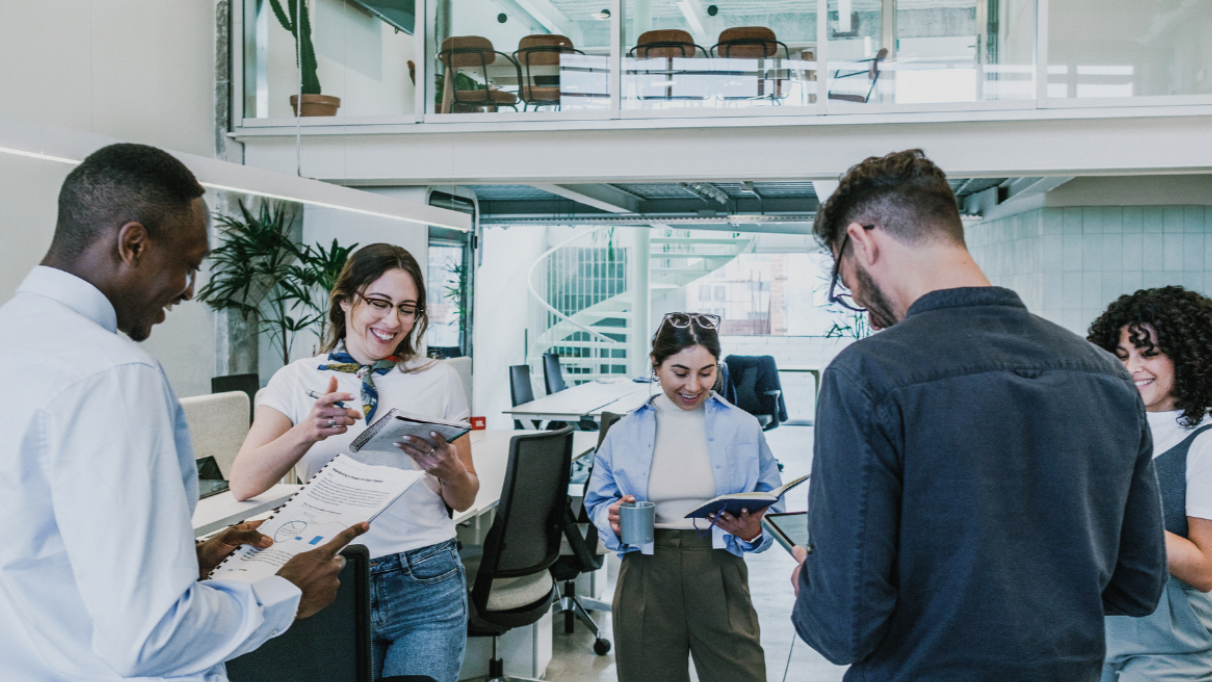
There’s been a lot of debate about whether the office still matters. Remote. Hybrid. Full return. Most companies are still trying to figure out what the “right” answer is.
But the real question isn’t should we go back?
It’s what are people being asked to return to?
For a long time, offices were designed for efficiency and oversight — bright fluorescent lights, rows of desks, and environments that prioritized output over people. That model worked for a while, but it doesn’t anymore. People have changed. Expectations have changed. And work has changed.
Most people don’t want to return to a space that feels cold, rushed, or disconnected. They want environments that feel intentional. Human. Supportive. Spaces that acknowledge how much the environment actually impacts how we think, feel, and perform.
Leaders are starting to say this out loud too. One McKinsey partner recently put it simply: you can’t just mandate people back without making the experience worth the commute. And that really gets to the heart of it. If the space doesn’t add value, people won’t feel motivated to show up — physically or emotionally.
The Office Isn’t Broken. The Approach Is.
A great workplace isn’t about trendy perks or expensive redesigns. It’s about alignment. About creating an environment that supports the people in it, not drains them.
At Quantum Sense, we talk about Soul Health — how people feel in a space based on how their senses interact with their environment. When things like light, sound, scent, and flow are considered intentionally, something shifts. People feel calmer. More focused. More creative. More engaged.
The office doesn’t need to be forced back into relevance. It needs to be reimagined in a way that supports the whole human — mentally, physically, and energetically.
Why One-Size-Fits-All Doesn’t Work
Every team is different. Every organization has its own rhythm. That’s why there’s no single solution that works for everyone.
Our work starts by listening — really listening. We look for the friction points. Where energy drops. Where creativity stalls. Where the space simply isn’t supporting the people inside it.
From there, we co-create environments that feel more aligned, more sensory, and more intentional. Spaces that don’t just look good, but feel good to be in.
Small Shifts That Make a Big Difference
Here are a few simple ways we begin supporting Soul Health through space — whether teams are in-office, hybrid, or fully remote:
-
Be intentional with scent.
Fragrance has a powerful impact on mood and clarity. Grounding scents like cedarwood or vetiver help people feel settled, while citrus or eucalyptus can bring a natural energy boost. Even remote teams can benefit from thoughtful scent-based touches. -
Design with the nervous system in mind.
Natural light, softer acoustics, organic textures, and visual calm help regulate the nervous system. When people feel calmer, productivity follows. -
Create space for rituals, not just meetings.
Rituals bring rhythm — whether it’s a shared moment at the start of a meeting, reflection time, or even a playlist. Rhythm builds culture in a way policies never will. -
Design for belonging.
Ask the simple question: Do people feel safe being themselves here? If the answer is no, no layout or furniture upgrade will fix that.
Why This Matters Right Now
Nearly half of workers say they’d be unlikely to stay in a job if the option to work from home were taken away. That’s not just about flexibility. It’s a signal that people want environments — physical or virtual — that respect how they work best.
The office isn’t dead.
But the old version of it is.
We have an opportunity to build something better. Spaces that support focus, creativity, and Soul Health in a way that actually feels good.
Because when a workplace supports the whole person, work stops feeling like something we push through — and starts feeling like something that sustains us. That’s the new paradigm.